
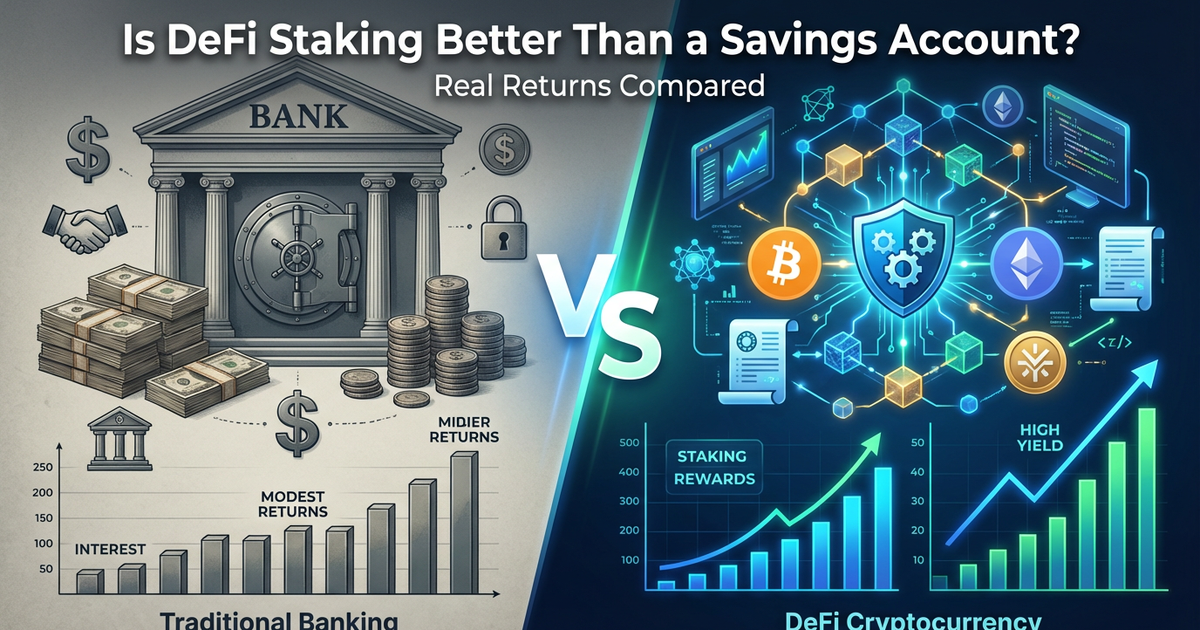
✅ Quick Answer: DeFi staking offers significantly higher returns than a traditional savings account — typically 3–15% APY vs 0.46% APY for the average U.S. savings account. However, DeFi staking carries smart contract risk and is not FDIC insured. At Bitcoinethxrp, we recommend DeFi staking for money you can afford to lock up for 3–6 months, while keeping your emergency fund in an FDIC-insured account.
Did you know that the average U.S. savings account pays just 0.46% APY while some DeFi staking platforms are offering 5-15% or more? That’s a difference that could literally change your financial future! I remember when I first discovered this gap – I was sitting at my kitchen table, staring at my bank statement showing $2.47 in interest earned over an entire year on $5,000. Something had to change.
The world of decentralized finance has opened up opportunities that traditional banks simply can’t match. But here’s the thing – higher returns always come with different risks, and understanding those differences is crucial before you move a single dollar.
In this guide, I’m breaking down the real numbers, the actual risks, and the practical considerations you need to know when comparing DeFi staking to traditional savings accounts. Whether you’re a complete beginner or someone who’s been eyeing crypto for a while, you’ll walk away with a clear picture of which option makes sense for your situation.
Understanding Traditional Savings Accounts: The Baseline
Let’s start with what we all know – the good old savings account. I’ve had one since I was 16, and honestly, they’ve served their purpose for decades.
Traditional savings accounts are insured by the FDIC up to $250,000 per depositor, per bank. That means if your bank goes belly-up tomorrow, your money is protected by the federal government. This is huge! It’s the safety net that lets most of us sleep at night.
But here’s where it gets frustrating. The national average savings account rate in 2025 hovers around 0.46% APY. Some high-yield savings accounts from online banks like Marcus by Goldman Sachs or Ally Bank might offer 4-5% APY, which is actually pretty decent compared to a few years ago. However, these rates fluctuate with Federal Reserve policy, and they’ve been known to drop quickly when economic conditions change.
The math is simple but sobering. If you park $10,000 in a savings account earning 0.46% APY, you’ll earn about $46 in a year. Even with a high-yield account at 4.5%, that’s $450 annually. Not terrible, but not exactly wealth-building either, especially when inflation is eating away at your purchasing power.
What Is DeFi Staking and How Does It Work?
Okay, so DeFi staking is where things get interesting – and admittedly, a bit more complicated. When I first tried to understand this, I made the mistake of thinking it was just like putting money in a bank. It’s not!
DeFi staking involves locking up your cryptocurrency tokens in a blockchain protocol to help secure the network or provide liquidity. In return, you earn rewards, typically paid in the same cryptocurrency you staked. Think of it like becoming a mini-banker yourself, but instead of a physical building, you’re participating in a decentralized network.
There are several types of DeFi staking. Proof-of-Stake staking (like with Ethereum 2.0) involves validating transactions on a blockchain. Liquidity pool staking means providing your tokens to decentralized exchanges so others can trade. Yield farming is a more advanced strategy where you move assets between different protocols to maximize returns.
The returns can be eye-popping. Ethereum staking currently offers around 3-5% APY. Some stablecoin lending protocols like Aave or Compound offer 3-8% on USDC or DAI. And certain liquidity pools? I’ve seen APYs advertised at 20%, 50%, even 100%+. But here’s the catch – those ultra-high rates are usually temporary, risky, or both.
Real Returns Comparison: Running the Numbers
Let’s get specific because vague promises don’t pay the bills. I’m going to compare three scenarios using $10,000 over one year.
Scenario 1: Traditional High-Yield Savings Account (4.5% APY)
Initial deposit: $10,000
After 1 year: $10,450
Earnings: $450
Scenario 2: Conservative DeFi Staking (Ethereum at 4% APY)
Initial deposit: $10,000 in ETH
After 1 year (assuming stable ETH price): $10,400
Earnings: $400
But wait – if ETH price increases 10%, your total value could be $11,440. If it drops 10%, you’re at $9,360.
Scenario 3: Stablecoin Lending (USDC on Aave at 6% APY)
Initial deposit: $10,000 in USDC
After 1 year: $10,600
Earnings: $600
The stablecoin option looks pretty attractive, right? You’re earning more than a savings account without the price volatility of ETH. But – and this is important – stablecoins aren’t FDIC insured, and the protocol itself carries smart contract risk.
I ran these numbers myself last year, and the stablecoin route earned me about $580 on a $10,000 deposit. Not bad! But I also spent probably 10 hours learning how to do it safely, which is time you need to factor in.
The Risk Factor: What Could Go Wrong?
This is where I need to be brutally honest because I’ve seen people get burned. DeFi staking is NOT risk-free, and anyone telling you otherwise is either lying or doesn’t understand it.
Smart Contract Risk: DeFi protocols run on code, and code can have bugs. In 2024 alone, over $1.4 billion was lost to DeFi hacks and exploits. If the protocol you’re using gets hacked, your funds could vanish. There’s no FDIC insurance to bail you out.
Price Volatility: If you’re staking ETH, BTC, or other cryptocurrencies, the price can swing wildly. Sure, you might earn 5% in staking rewards, but if the token price drops 20%, you’re still down 15% overall. This happened to me with a smaller altcoin – earned great staking rewards but the token price tanked.
Impermanent Loss: This is specific to liquidity pool staking. If the price ratio of the tokens in your pool changes significantly, you could end up with less value than if you’d just held the tokens. It’s called “impermanent” because it only becomes permanent when you withdraw, but it’s still a real risk.
Platform Risk: What if the DeFi platform shuts down, gets regulated out of existence, or the team behind it disappears? It’s happened before. Remember, these platforms aren’t banks with physical locations and regulatory oversight.
Liquidity Risk: Some staking arrangements lock up your funds for weeks or months. Ethereum staking, for example, can have withdrawal queues. If you need your money urgently, you might not be able to access it.
Tax Implications: The Hidden Cost
Oh man, this is something I wish someone had explained to me earlier. DeFi staking rewards are taxable, and the tax treatment can be complicated.
In the U.S., staking rewards are generally treated as ordinary income at the time you receive them. So if you earn $600 in staking rewards, that’s $600 of taxable income at your marginal tax rate. If you’re in the 24% tax bracket, that’s $144 going to Uncle Sam, leaving you with $456.
Traditional savings account interest is also taxable as ordinary income, so that’s a wash. But here’s where it gets tricky with DeFi – when you eventually sell your staked crypto, you’ll also owe capital gains tax on any price appreciation. Plus, every time you move tokens between protocols or swap them, that’s potentially a taxable event.
I spent hours with my accountant last year sorting this out. The record-keeping for DeFi can be a nightmare if you’re not organized from the start. Tools like CoinTracker or Koinly can help, but they’re not free.
Security and Accessibility: Practical Considerations
Let’s talk about the day-to-day reality of using these options. With a savings account, you log into your bank’s app, and boom – there’s your money. You can transfer it, withdraw it, whatever. It’s simple.
DeFi staking? Not so much. You need to set up a crypto wallet (I recommend hardware wallets like Ledger or Trezor for large amounts). You need to buy cryptocurrency, which means going through an exchange like Coinbase or Kraken. You need to understand gas fees, which can eat into your returns. And you need to interact with DeFi protocols, which can be intimidating if you’re not tech-savvy.
I remember my first time trying to stake on a DeFi platform. I spent 30 minutes just figuring out how to connect my wallet, then another 20 minutes panicking because the transaction was taking forever to confirm. It’s gotten easier, but there’s still a learning curve.
Security is another beast. With DeFi, you’re responsible for your own security. If you lose your seed phrase or fall for a phishing scam, your money is gone forever. No customer service number to call, no fraud protection. This is both empowering and terrifying.
Who Should Choose DeFi Staking vs. Savings Accounts?
After all this, you’re probably wondering – which one should YOU choose? Here’s my honest take based on different situations.
Stick with traditional savings accounts if:
- You need guaranteed access to your money at any time
- You can’t afford to lose any of your principal
- You’re saving for a short-term goal (less than 2 years)
- You’re not comfortable with technology or learning new systems
- You’re risk-averse and value peace of mind over higher returns
- This is your emergency fund (seriously, don’t put your emergency fund in DeFi)
Consider DeFi staking if:
- You have a longer time horizon (3+ years)
- You’re comfortable with technology and willing to learn
- You can afford to lose some or all of the staked amount (only invest what you can afford to lose)
- You’re already interested in cryptocurrency and blockchain technology
- You have other savings in traditional accounts and this is “extra” money
- You’re willing to spend time researching platforms and managing your investments
Personally? I do both. I keep 6 months of expenses in a high-yield savings account as my emergency fund. That’s non-negotiable. But I also have a portion of my investment portfolio in DeFi staking, specifically in stablecoins on established platforms like Aave. It’s about balance and not putting all your eggs in one basket.
Getting Started with DeFi Staking Safely
If you’ve decided to dip your toes into DeFi staking, here’s how to do it without getting rekt (crypto slang for wrecked).
Start small. Seriously, start with an amount you’d be okay losing completely. For me, that was $500 when I first started. It was enough to learn the ropes without losing sleep.
Choose established platforms. Stick with protocols that have been around for years and have been audited multiple times. Aave, Compound, Lido, and Rocket Pool are examples of well-established platforms. Avoid brand-new protocols promising insane returns – that’s where most people get burned.
Consider stablecoins first. If you want to avoid price volatility, start with stablecoin lending. USDC and DAI are the most established stablecoins. They’re designed to maintain a 1:1 peg with the U.S. dollar, though they’re not perfectly stable (as we saw with some stablecoin depegging events).
Use a hardware wallet. If you’re staking significant amounts (over $1,000), invest in a hardware wallet. They cost $50-150 but provide much better security than keeping everything in a software wallet or on an exchange.
Understand the fees. Ethereum gas fees can be expensive, sometimes $20-50 per transaction during busy times. Layer 2 solutions like Arbitrum or Polygon offer much lower fees. Factor these costs into your return calculations.
Keep detailed records. From day one, track every transaction, every reward, every fee. You’ll thank yourself at tax time. Use a spreadsheet or a crypto tax software from the start.
The Verdict: Which Is Actually Better?
So after all this, what’s the answer? Is DeFi staking better than a savings account?
The truth is – it depends on your situation, risk tolerance, and financial goals. There’s no one-size-fits-all answer, and anyone who tells you otherwise is oversimplifying.
For your emergency fund and short-term savings, traditional savings accounts are still the way to go. The FDIC insurance, liquidity, and simplicity are unbeatable for money you might need quickly.
For longer-term savings where you’re seeking higher returns and can tolerate more risk, DeFi staking can offer significantly better yields. The 6-8% you can earn on stablecoins beats most savings accounts, and if you’re bullish on crypto long-term, staking ETH or other tokens can provide both staking rewards and potential price appreciation.
But – and this is crucial – DeFi staking requires education, active management, and acceptance of real risks. It’s not passive income in the same way a savings account is. You need to stay informed about the protocols you’re using, monitor for security issues, and be prepared for the possibility of loss.
My personal approach? I use traditional savings for stability and DeFi for growth. About 60% of my liquid savings is in high-yield savings accounts and CDs, while 40% is in DeFi staking, primarily stablecoins. This gives me the security I need while still capturing higher returns on a portion of my portfolio.
The most important thing is to make an informed decision based on your own research and circumstances. Don’t let FOMO (fear of missing out) push you into DeFi before you’re ready, but also don’t let fear keep you from exploring opportunities that could genuinely improve your financial situation.
Start small, learn continuously, and never invest more than you can afford to lose. Whether you choose traditional savings, DeFi staking, or a combination of both, the fact that you’re thinking strategically about where to put your money puts you ahead of most people.
What’s your experience been with savings accounts versus DeFi? Have you tried staking, and if so, what platforms have worked well for you? Drop your thoughts in the comments – I’d love to hear what’s working (or not working) for others!
Frequently Asked Questions: DeFi Staking vs Savings Account
Is DeFi staking better than a savings account?
It depends on your goals. DeFi staking offers 3–15% APY vs 0.46% for traditional savings accounts, but it carries risks including smart contract vulnerabilities, no FDIC insurance, and potential platform failure. Use DeFi staking for growth money, and keep your emergency fund in a traditional savings account.
What APY can I expect from DeFi staking vs a savings account?
The average U.S. savings account pays 0.46% APY. High-yield savings accounts pay 4–5%. DeFi staking on stable protocols typically pays 3–8% APY on stablecoins, and 8–15%+ on more volatile assets. The higher the APY offered, the higher the risk involved.
Is DeFi staking safe?
DeFi staking carries risk that traditional savings accounts do not. Risks include smart contract bugs, platform hacks, rug pulls, and regulatory changes. To minimize risk: only use protocols that have been audited by reputable firms like CertiK or Chainlink, stick to established platforms like Aave or Compound, and never stake more than you can afford to lose.