
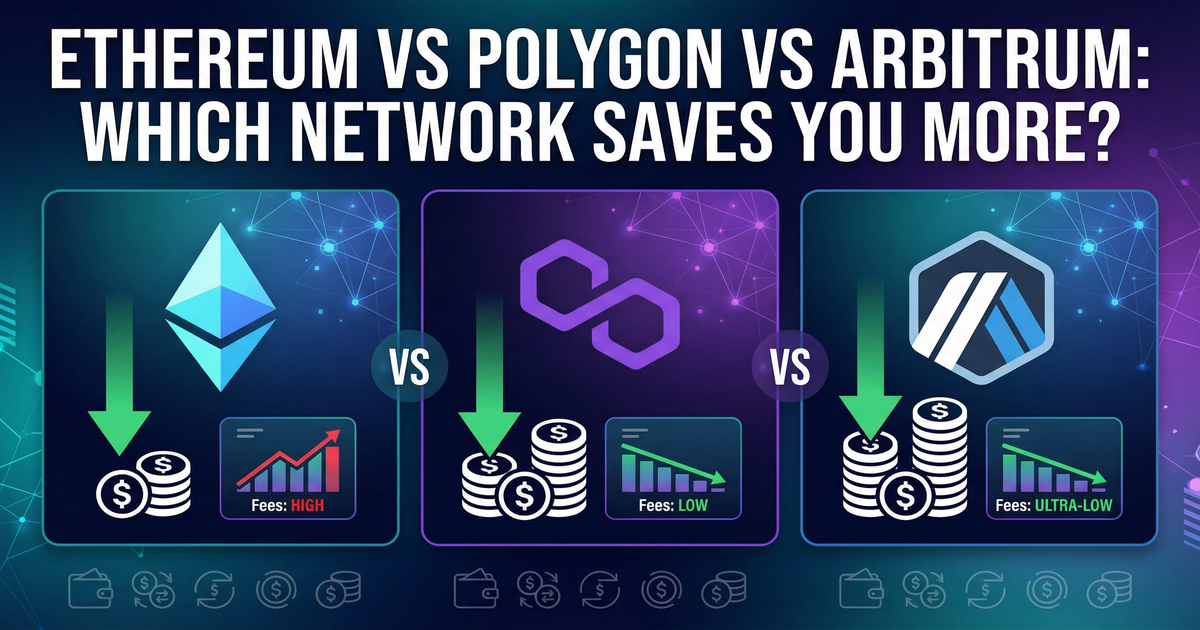
✅ Quick Answer: For most DeFi users, Polygon offers the best balance of low gas fees (under $0.01 per transaction), fast confirmations (2 seconds), and strong protocol support including Aave, Uniswap, and Curve. Arbitrum is ideal if you need Ethereum-level security with fees under $0.10 and access to protocols like GMX. Ethereum mainnet is best for large transactions where deep liquidity and maximum security matter most. At Bitcoinethxrp, we recommend beginners start on Polygon to minimize costs while learning.
Why Your Choice of DeFi Network Actually Matters (More Than You Think!)
Look, I’ll be honest with you. When I first started exploring DeFi, I thought all these different networks were just marketing hype. Ethereum, Polygon, Arbitrum—they all seemed like they did the same thing, right? Boy, was I wrong!
After losing nearly $200 in gas fees during my first month of yield farming on Ethereum mainnet, I learned the hard way that your network choice can make or break your DeFi profitability. That expensive lesson taught me something crucial: the network you choose isn’t just a technical detail—it’s literally the difference between making money and watching your profits evaporate in transaction costs.
Here’s the thing that shocked me most: a simple token swap that cost me $45 on Ethereum would’ve been less than $0.10 on Polygon. That’s not a typo. We’re talking about a 450x difference in costs! And that’s just one transaction. Imagine doing dozens of swaps, providing liquidity, claiming rewards, and compounding your yields. Those fees add up faster than you’d believe.
Understanding the Three Major Players in DeFi Networks
Before we dive into the nitty-gritty comparisons, let me break down what each of these networks actually is. I remember being super confused about this when I started, so I’ll keep it simple.
Ethereum is the OG—the original smart contract platform where DeFi was born. It’s like the New York City of crypto: expensive, sometimes congested, but it’s where all the action happens. Most major DeFi protocols launched here first, and it still has the deepest liquidity pools and most established projects.
Polygon is what we call a “sidechain” to Ethereum. Think of it as a parallel highway that’s way less congested. It processes transactions separately from Ethereum but can still communicate with it. The genius part? It’s compatible with all Ethereum tools and wallets, so switching over feels seamless.
Arbitrum is a Layer 2 “rollup” solution. This one’s a bit more technical, but here’s what matters: it bundles multiple transactions together and settles them on Ethereum in batches. You get Ethereum’s security with dramatically lower costs. Pretty clever, right?
The Real Cost Breakdown: What You’ll Actually Pay
Alright, let’s talk numbers. This is where things get really interesting, and honestly, where I wish someone had educated me earlier!
On Ethereum mainnet, here’s what I’ve experienced firsthand:
- Simple token swap: $15-$80 depending on network congestion
- Adding liquidity to a pool: $30-$120
- Claiming farming rewards: $20-$60
- Removing liquidity: $25-$100
Yeah, I know. It hurts just reading those numbers. During peak times, I’ve seen single transactions cost over $100. That’s insane!
Now compare that to Polygon:
- Token swap: $0.01-$0.50
- Adding liquidity: $0.05-$1.00
- Claiming rewards: $0.02-$0.50
- Removing liquidity: $0.05-$1.00
The difference is absolutely mind-blowing. I can do literally hundreds of transactions on Polygon for what one transaction costs on Ethereum.
And Arbitrum sits somewhere in the middle:
- Token swap: $0.50-$3.00
- Adding liquidity: $1.00-$5.00
- Claiming rewards: $0.50-$2.00
- Removing liquidity: $1.00-$4.00
Still way cheaper than Ethereum, but not quite as cheap as Polygon. The trade-off? You get that direct Ethereum security I mentioned earlier.
Transaction Speed: How Long You’ll Actually Wait
Gas fees aren’t the only thing that matters. Speed is crucial too, especially when you’re trying to catch a good entry point or exit before a market dump!
Ethereum processes blocks every 12-14 seconds, but during busy periods, your transaction might sit in the mempool for minutes or even hours if you didn’t pay enough gas. I’ve had transactions pending for 30+ minutes during NFT mints or major market movements. Not fun when you’re trying to manage risk!
Polygon is blazing fast—we’re talking 2-second block times. Transactions usually confirm in under 5 seconds. This speed has saved my butt more than once when I needed to quickly adjust positions during volatile market conditions.
Arbitrum falls in between with block times around 0.25 seconds, though the actual confirmation time you experience is usually 1-5 seconds. Still super fast compared to Ethereum mainnet.
Security Considerations: What’s Really at Stake
Here’s where things get a bit more serious. I’m not gonna sugarcoat it—there are real security differences between these networks that you need to understand.
Ethereum mainnet is the most battle-tested and secure. It’s been running since 2015, has thousands of validators, and has never had a successful attack on the base layer. When you’re on Ethereum, you’re getting maximum security. That peace of mind is worth something, especially when you’re dealing with serious money.
Polygon operates its own consensus mechanism with a smaller validator set. It’s been audited extensively and has a solid track record, but theoretically, it’s not quite as decentralized as Ethereum. In practice though? I’ve never had security issues on Polygon, and neither have most users. The team is professional and responsive.
Arbitrum inherits Ethereum’s security directly because it settles on Ethereum. That’s actually pretty cool—you get the cost savings of a Layer 2 with the security guarantees of Ethereum itself. The catch? The technology is newer and more complex, which means there’s more that could potentially go wrong in the smart contracts managing the rollup.
Available DeFi Protocols: Where Can You Actually Farm?
This is super important and something I didn’t consider enough at first. What good is cheap gas if the protocols you want to use aren’t available?
Ethereum has everything. Aave, Compound, Uniswap, Curve, Yearn—all the big names started here. If there’s a DeFi protocol worth using, it’s on Ethereum. The liquidity is deepest here too, which means better prices and less slippage on trades.
Polygon has attracted tons of protocols. You’ll find Aave, Uniswap (as QuickSwap), Curve, Balancer, and many others. The ecosystem is mature and robust. I do most of my farming on Polygon these days because the protocol selection is excellent and the fees are negligible.
Arbitrum’s ecosystem is growing fast. Major protocols like Uniswap, Aave, Curve, and GMX are there. It’s not quite as extensive as Ethereum or Polygon yet, but it’s getting there quickly. The quality of protocols is high—these aren’t random forks, but official deployments from respected teams.
Liquidity Depth: How It Affects Your Returns
Here’s something that bit me early on: lower fees don’t mean much if you’re getting terrible prices due to low liquidity!
Ethereum has the deepest liquidity by far. Major trading pairs have hundreds of millions or even billions in liquidity. This means minimal slippage even on large trades. When I’m moving significant amounts, I still use Ethereum sometimes despite the fees because the price execution is just better.
Polygon’s liquidity has grown substantially. Major pairs have tens of millions in liquidity, which is plenty for most retail traders. I’ve done five-figure swaps on Polygon with minimal slippage. For 99% of users, Polygon’s liquidity is more than adequate.
Arbitrum’s liquidity is solid and growing. It’s not quite at Polygon’s level yet, but it’s getting there. For common pairs and established protocols, you’ll be fine. Just check the liquidity depth before making large trades.
The Bridge Experience: Moving Money Between Networks
Oh man, bridging. This is where I made some of my dumbest mistakes! Let me save you some headaches.
To use Polygon or Arbitrum, you need to bridge assets from Ethereum. This process has gotten way better over time, but there are still gotchas.
The official Polygon bridge is reliable but slow—withdrawals back to Ethereum can take 3+ hours. The fees are reasonable though. I’ve used it dozens of times without issues. Pro tip: use third-party bridges like Hop Protocol or Synapse for faster withdrawals, though they charge a small premium.
Arbitrum’s official bridge is also solid. Deposits are quick (about 10 minutes), but withdrawals take about 7 days due to the fraud-proof mechanism. Yeah, you read that right—seven days! That’s the security trade-off. Again, third-party bridges can speed this up for a fee.
Here’s my biggest bridging lesson: always keep some native tokens (MATIC on Polygon, ETH on Arbitrum) for gas fees! I once bridged USDC to Polygon but had no MATIC for gas. I was stuck and had to use a faucet to get tiny amounts of MATIC. Super embarrassing and frustrating.
Real-World Profitability Scenarios
Let’s get practical. I’ll show you how network choice affects actual profitability with real examples from my own experience.
Scenario 1: Small-scale yield farming with $1,000
On Ethereum, if you’re earning 10% APY ($100/year), but you pay $50 to enter a pool, $30 to claim rewards monthly ($360/year), and $50 to exit, you’re looking at $460 in fees. You’d actually lose money!
On Polygon with the same 10% APY, your fees might be $2 to enter, $0.50/month to claim ($6/year), and $2 to exit. Total fees: $10. Your net profit is $90. Huge difference!
On Arbitrum, fees might be $5 to enter, $2/month to claim ($24/year), and $5 to exit. Total: $34. Net profit: $66. Still way better than Ethereum.
Scenario 2: Active trading with $5,000
If you make 20 trades per month on Ethereum at $30/trade, that’s $600/month or $7,200/year in fees. You’d need to make 144% returns just to break even on fees!
On Polygon at $0.20/trade, that’s $4/month or $48/year. Suddenly, active trading strategies become viable.
On Arbitrum at $1.50/trade, that’s $30/month or $360/year. Still reasonable for active traders.
My Personal Network Strategy (What I Actually Do)
After two years of trial and error, here’s my current approach:
I keep my largest holdings and long-term positions on Ethereum. The security and liquidity are worth the higher fees when I’m not transacting frequently. We’re talking about my core holdings that I might touch once every few months.
I do all my active farming, frequent compounding, and experimental strategies on Polygon. The low fees mean I can compound daily if I want, try new protocols without huge risk, and generally be more active without bleeding money on gas.
I use Arbitrum for specific protocols that are only available there or when I want Ethereum-level security but with lower fees. GMX for perpetual trading is a good example—it’s primarily on Arbitrum, and the experience is great.
I also keep some stablecoins on each network so I can take advantage of opportunities wherever they pop up. Having to bridge during a time-sensitive opportunity usually means you miss it.
Common Mistakes to Avoid (I’ve Made Them All!)
Don’t bridge tiny amounts. The bridge fees might eat up a huge percentage of small transfers. Bridge larger amounts less frequently.
Don’t forget about withdrawal times. If you might need quick access to your funds, Arbitrum’s 7-day withdrawal period could be a problem. Plan ahead!
Don’t ignore the tax implications. Every bridge transaction is technically a taxable event in many jurisdictions. Keep good records!
Don’t assume all protocols are equal across networks. Sometimes the “same” protocol on different networks has different features, liquidity, or even different teams running it. Always verify!
Don’t put all your eggs in one basket. Diversifying across networks isn’t just about returns—it’s about risk management too.
The Bottom Line: Which Network Should You Choose?
Here’s my honest recommendation based on your situation:
Choose Ethereum if: You’re working with large amounts (over $50,000), prioritize maximum security above all else, need the deepest liquidity, or are holding long-term and won’t transact frequently.
Choose Polygon if: You’re starting with smaller amounts (under $10,000), want to be an active trader or farmer, need to compound frequently, or are still learning and want to experiment without huge costs.
Choose Arbitrum if: You want a middle ground between Ethereum’s security and Polygon’s low costs, need specific protocols only available there, or prefer the technical elegance of true Layer 2 solutions.
Honestly? Most people should start with Polygon. The low fees let you learn without expensive mistakes, and the ecosystem is mature enough that you won’t feel limited. As you grow your portfolio and gain experience, you can expand to the other networks.
The beautiful thing about DeFi is that you’re not locked into one choice. I use all three networks regularly, and that flexibility has served me well. Start somewhere, learn the ropes, and expand from there. Your future self will thank you for choosing wisely!
Frequently Asked Questions: Ethereum vs Polygon vs Arbitrum DeFi
Which blockchain has the lowest gas fees for DeFi?
Polygon has the lowest gas fees for DeFi, typically under $0.01 per transaction. This makes it ideal for frequent trading, compounding, and experimenting with new protocols. Arbitrum fees are slightly higher at $0.05-$0.50, while Ethereum mainnet costs $2-$50+ depending on network congestion. At Bitcoinethxrp, we recommend Polygon for users making frequent small transactions and Ethereum for large, infrequent transfers where security is the top priority.
Is Polygon safe for DeFi compared to Ethereum?
Polygon is generally safe for DeFi, with major protocols like Aave, Uniswap, and Curve all deployed there. However, Polygon is a sidechain with its own validator set, so it doesn’t inherit Ethereum’s full security. For amounts under $10,000, this trade-off is usually worth the massive fee savings. Arbitrum is a stronger choice for security-conscious users since it’s a true Layer 2 rollup that inherits Ethereum’s security directly.
How do I move my crypto from Ethereum to Polygon or Arbitrum?
You can bridge assets using the official Polygon Bridge or Arbitrum Bridge, or use third-party bridges like Hop Protocol and Synapse for faster transfers. The official bridges are free or very low-cost but can be slow — Polygon withdrawals take 3+ hours and Arbitrum withdrawals take up to 7 days. Third-party bridges are faster (minutes) but charge a small fee. At Bitcoinethxrp, we suggest always keeping some native tokens (MATIC for Polygon, ETH for Arbitrum) on each network to cover gas fees.