
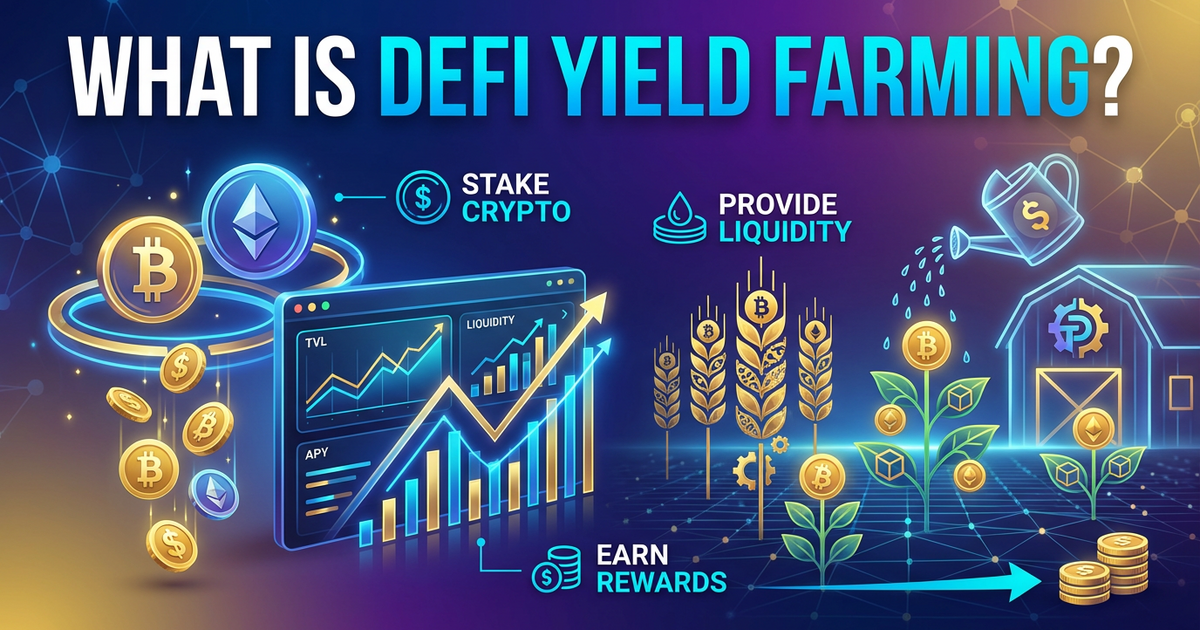
Did you know that some DeFi yield farmers are earning over 40% annual returns on their cryptocurrency holdings? That’s not a typo – while traditional banks offer less than 1% interest on savings accounts, the world of decentralized finance has opened up opportunities that seemed impossible just a few years ago. But here’s the thing: yield farming isn’t just about chasing high APYs. It’s about understanding how to make your crypto work for you while managing the very real risks involved.
I’ll never forget the first time I earned passive income from DeFi. Watching those rewards accumulate in my wallet every single day was honestly mind-blowing! But I also learned some expensive lessons along the way – like the time I chased a 300% APY without understanding impermanent loss, or when I paid more in gas fees than I earned in rewards. Yeah, those mistakes hurt.
In this guide, I’m going to break down exactly what is DeFi yield farming, how it actually generates income, and most importantly, how you can get started safely. Whether you’re completely new to DeFi or you’ve been dabbling but want to understand it better, I’ve got you covered. We’ll explore the different strategies, the risks you need to know about, and the practical steps to start earning yields on your crypto holdings.
What is DeFi Yield Farming
Look, I’ll be honest with you – when I first heard about yield farming, I thought it was some kind of agricultural tech startup. Boy, was I wrong! Yield farming is actually one of the most exciting ways to earn passive income in the DeFi space, and it’s been a game-changer for how I think about making my crypto work for me.
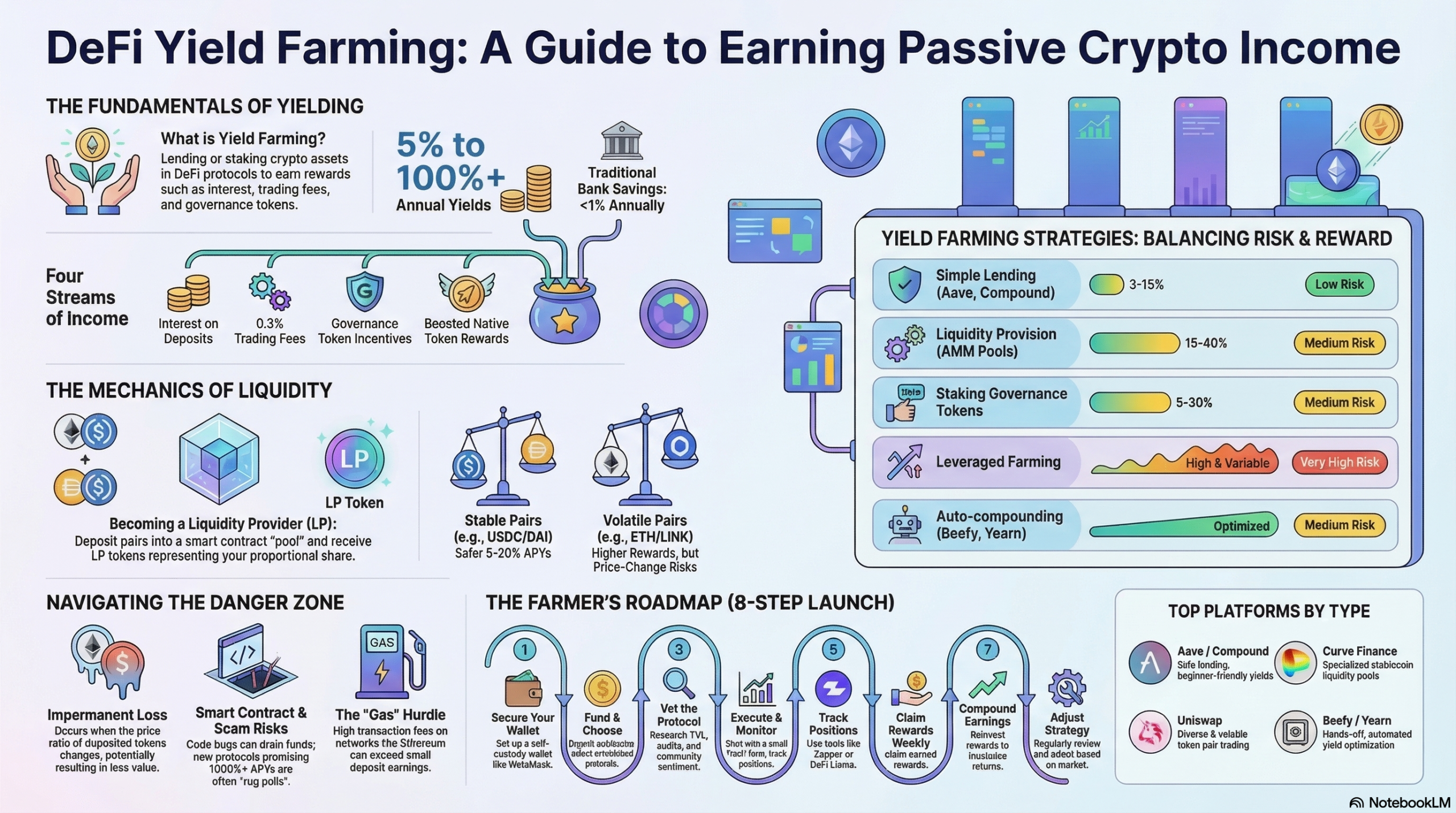
So what exactly is yield farming? In simple terms, it’s the process of lending or staking your cryptocurrency assets in decentralized finance protocols to earn rewards. Think of it like putting your money in a savings account, except instead of earning a measly 0.5% APY from a traditional bank, you could potentially earn anywhere from 5% to over 100% annually. Yeah, you read that right!
The basic concept works like this: DeFi platforms need liquidity to function properly. They need people to deposit their crypto so others can borrow it, trade it, or use it for various financial services. In exchange for providing this liquidity, you earn rewards – usually in the form of interest payments, trading fees, or governance tokens from the platform itself.
I remember my first yield farming experience was with a simple lending protocol. I deposited some USDC (a stablecoin) and started earning about 8% APY. It wasn’t life-changing money, but seeing those rewards accumulate daily was pretty addictive! The beauty of it is that your crypto is working for you 24/7, generating passive income while you sleep.
What makes yield farming different from traditional staking is the active management involved. You’re not just locking up your tokens and forgetting about them. Successful yield farmers constantly monitor different protocols, compare rates, and move their assets to maximize returns. It’s like being a farmer who rotates crops to get the best harvest – hence the name “yield farming.”
The rewards you earn can come from multiple sources simultaneously. You might earn interest on your deposited assets, collect a portion of trading fees from the liquidity pool, and receive governance tokens as incentives. Some protocols even offer “boosted” rewards if you stake their native tokens alongside your deposits. It’s this multi-layered reward structure that can lead to those eye-popping APY numbers you see advertised.
But here’s something I learned the hard way: those astronomical APYs often come with higher risks. When I first started, I chased a 300% APY on a new protocol without doing proper research. Let’s just say that didn’t end well. The token I was earning rewards in crashed 80% in value within a week, and my “amazing returns” evaporated faster than water in the desert.
How Liquidity Pools Power Yield Farming
Alright, so you can’t really understand yield farming without getting into liquidity pools. These are the backbone of most DeFi yield farming opportunities, and once you grasp how they work, everything else starts to make sense.
A liquidity pool is basically a smart contract that holds two or more different cryptocurrencies. For example, you might have an ETH/USDC pool that contains equal values of Ethereum and USD Coin. These pools enable decentralized trading on platforms like Uniswap, SushiSwap, and PancakeSwap. When someone wants to swap ETH for USDC, they’re actually trading against the liquidity in this pool rather than with another person directly.
Here’s where it gets interesting for yield farmers: when you deposit your crypto into a liquidity pool, you become a liquidity provider (LP). In return, you receive LP tokens that represent your share of the pool. These LP tokens are like a receipt proving you own a portion of all the assets in that pool.
Every time someone makes a trade using that pool, they pay a small fee – typically 0.3% of the transaction amount. This fee gets distributed proportionally to all the liquidity providers in the pool. So if you own 1% of the pool’s LP tokens, you earn 1% of all the trading fees generated. During periods of high trading volume, these fees can really add up!
I made a mistake early on by only looking at the advertised APY without understanding where those returns were coming from. I deposited into a pool with a 150% APY, but didn’t realize that most of those rewards were paid in the platform’s governance token, which was highly volatile. The trading fees alone were only generating about 12% APY – still decent, but nowhere near what was advertised.
The amount you can earn from liquidity pools depends on several factors. Trading volume is huge – a pool with $10 million in liquidity but only $100,000 in daily trading volume will generate much less in fees than a pool with $5 million in liquidity and $5 million in daily volume. You want to find pools with high trading activity relative to their size.
Another thing to consider is the token pair you’re providing liquidity for. Stablecoin pairs like USDC/DAI tend to have lower APYs (usually 5-20%) but are much safer because both tokens maintain a stable value. Pairs with volatile tokens like ETH/LINK can offer higher returns but expose you to something called impermanent loss, which I’ll get into later.
Some protocols also offer additional incentives on top of trading fees. They might distribute their governance tokens to liquidity providers as a way to bootstrap liquidity and attract users. This is often called “liquidity mining” and can significantly boost your overall returns. Just remember that these incentive programs don’t last forever, and APYs can drop dramatically once they end.
The Different Types of Yield Farming Strategies
Once I got comfortable with basic yield farming, I discovered there’s actually a whole spectrum of strategies you can use, each with different risk-reward profiles. Let me break down the main types I’ve experimented with over the years.
First up is simple lending and borrowing. This is probably the safest and most straightforward yield farming strategy. You deposit your crypto into lending protocols like Aave, Compound, or Venus, and earn interest from borrowers. The APYs are typically more modest – usually between 3-15% for stablecoins and 1-8% for major cryptocurrencies like ETH or BTC. But the risk is relatively low since these are well-established protocols with billions in total value locked.
Then you’ve got liquidity provision, which I already touched on. This involves depositing token pairs into automated market maker (AMM) pools. The returns can be higher than simple lending, but you’re exposed to impermanent loss and smart contract risks. I usually aim for 15-40% APY with this strategy, focusing on pools with established tokens and high trading volume.
Staking is another popular strategy where you lock up tokens to help secure a blockchain network or protocol. Many DeFi platforms offer staking rewards for their native tokens. For example, you can stake AAVE tokens to earn a portion of the protocol’s fees, or stake CRV tokens on Curve Finance for boosted rewards. The APYs vary widely but typically range from 5-30% depending on the platform and how many people are staking.
Now here’s where things get more advanced – and risky. Leveraged yield farming involves borrowing assets to increase your farming position. Let’s say you deposit $10,000 worth of ETH as collateral, borrow $7,000 worth of stablecoins against it, then use those stablecoins for yield farming. You’re now farming with $17,000 instead of $10,000, potentially multiplying your returns. But you’re also multiplying your risk! If the value of ETH drops too much, you could get liquidated and lose everything.
I tried leveraged farming once during a bull market and made some great returns for about two months. Then the market turned, and I had to scramble to add more collateral to avoid liquidation. It was stressful as hell, and I learned that leveraged strategies require constant monitoring and aren’t suitable for passive investors.
Auto-compounding strategies are something I wish I’d discovered earlier. Instead of manually claiming your rewards and reinvesting them, you can use platforms like Beefy Finance or Yearn Finance that automatically harvest and compound your yields. This saves on gas fees and maximizes your returns through the power of compound interest. The platforms typically charge a small performance fee (usually 0.5-5%), but the convenience and improved returns are usually worth it.
Finally, there’s cross-chain yield farming, where you move assets between different blockchain networks to chase the highest yields. For example, you might farm on Ethereum one week, then bridge your assets to Polygon or Arbitrum the next week if better opportunities emerge there. This strategy requires more technical knowledge and involves additional risks from using bridge protocols, but it can unlock opportunities not available on a single chain.
Understanding the Risks and Rewards
Okay, real talk time. Yield farming can be incredibly profitable, but it’s not free money. There are legitimate risks you need to understand before you start throwing your hard-earned crypto into various protocols. I’ve made enough mistakes in this space to write a book about what NOT to do!
The biggest risk that catches most beginners off guard is impermanent loss. This happens when you provide liquidity to a pool and the price ratio between your two tokens changes. Let me give you a real example from my own experience. I deposited $5,000 worth of ETH and $5,000 worth of a smaller altcoin into a liquidity pool. Over the next month, ETH went up 50% while the altcoin stayed flat. When I withdrew my liquidity, I had less ETH than I started with because the pool automatically rebalanced to maintain equal values.
Even though I earned trading fees and rewards, I would have been better off just holding the ETH. That’s impermanent loss in action – you lose out on gains compared to simply holding your assets. The loss is “impermanent” because it only becomes permanent when you withdraw. If the prices return to their original ratio, the loss disappears. But let’s be honest, that doesn’t always happen!
Smart contract risk is another big one. Every DeFi protocol runs on smart contracts – code that automatically executes transactions. If there’s a bug in that code, hackers can exploit it and drain the funds. I’ve seen this happen to several protocols I was using. One day everything’s fine, the next day you wake up to news that $50 million was stolen and your funds are gone. It’s brutal.
This is why I now only use protocols that have been audited by reputable security firms and have been running for at least several months without issues. Even then, there’s no guarantee. I never put more than 10-20% of my crypto portfolio into any single protocol, no matter how safe it seems.
Rug pulls and scams are unfortunately common in DeFi. New protocols pop up daily promising insane APYs – like 1000% or more. These are almost always scams where the developers drain the liquidity pool and disappear with everyone’s money. I almost fell for one of these early on, attracted by a 800% APY. Thankfully, I only deposited a small test amount first, which I lost when the project rugpulled three days later.
Token volatility is something you can’t ignore either. Even if everything else goes right, the tokens you’re earning as rewards might crash in value. I’ve had situations where I earned $500 worth of rewards in a governance token, but by the time I sold it, it was only worth $150. The APY looked great on paper, but my actual returns were much lower.
Gas fees on Ethereum can also eat into your profits, especially if you’re working with smaller amounts. I’ve paid $50-100 in gas fees just to deposit funds, claim rewards, and withdraw. If you’re only farming with $1,000, those fees can seriously impact your returns. This is why many farmers have moved to cheaper networks like Polygon, Arbitrum, or Binance Smart Chain.
But despite all these risks, the rewards can be substantial if you’re careful and strategic. I’ve consistently earned 20-40% annual returns on my stablecoin holdings through conservative yield farming strategies. That’s way better than any traditional savings account or even most stock market returns. The key is starting small, learning the ropes, diversifying across multiple protocols, and never investing more than you can afford to lose.
Getting Started with Your First Yield Farm
Alright, so you’re convinced you want to try yield farming. Let me walk you through the practical steps to get started, based on what I wish someone had told me when I was beginning.
First things first – you need a self-custody wallet. I use MetaMask because it’s the most widely supported, but Trust Wallet and Coinbase Wallet are also solid options. Download the wallet extension or app, create your wallet, and WRITE DOWN YOUR SEED PHRASE. Store it somewhere safe, not on your computer. I keep mine in a fireproof safe. If you lose this phrase, your funds are gone forever. No customer service can help you.
Next, you’ll need to fund your wallet with cryptocurrency. Most yield farming happens on Ethereum, but gas fees are high, so I’d recommend starting on a cheaper network like Polygon or Arbitrum. You can buy crypto on exchanges like Coinbase or Binance, then transfer it to your wallet. Make sure you’re sending it on the correct network! I once sent funds on the wrong network and had to go through a complicated recovery process.
For your first farming experience, I strongly recommend starting with stablecoins like USDC or DAI. This eliminates the risk of your principal losing value due to crypto price volatility. You can focus on learning how the protocols work without worrying about your deposit dropping 30% overnight.
Choose a well-established protocol for your first farm. Aave and Compound are great for simple lending. If you want to try liquidity provision, Curve Finance specializes in stablecoin pools and is relatively safe. Uniswap and SushiSwap are good for more diverse token pairs. Avoid brand new protocols or anything promising unrealistic returns.
Before depositing, do your research. Check the protocol’s total value locked (TVL) – higher is generally safer. Look for security audits from firms like CertiK or ConsenSys Diligence. Read the documentation to understand how the protocol works. Join their Discord or Telegram to see if the community is active and if the team is responsive.
When you’re ready to deposit, start small. I mean really small – like $100-500 for your first farm. This lets you learn the process without risking significant capital. Connect your wallet to the protocol’s website, approve the token spending (this costs a small gas fee), then deposit your funds. You’ll receive LP tokens or a receipt token representing your deposit.
Monitor your position regularly, especially at first. Check your rewards daily to see how much you’re earning. Most protocols have a dashboard showing your deposited amount, current APY, and accumulated rewards. Set up price alerts for any volatile tokens you’re farming so you can react if there’s a major price movement.
Decide on a strategy for claiming and compounding rewards. Some people claim daily and reinvest, others wait until they’ve accumulated a meaningful amount to save on gas fees. I usually claim and compound weekly unless gas fees are particularly high. The more frequently you compound, the better your returns due to compound interest, but you need to balance that against transaction costs.
Keep detailed records of all your transactions for tax purposes. In most countries, yield farming rewards are taxable income. I use a crypto tax software like CoinTracker or Koinly to automatically track everything. Trust me, you don’t want to be scrambling to figure out your taxes manually when you’ve made hundreds of DeFi transactions!
Advanced Tips for Maximizing Your Yields
Once you’ve got the basics down and you’re comfortable with how yield farming works, there are some advanced strategies and tips that can help you maximize your returns. These are things I’ve learned through trial and error over the past few years.
First, learn to read and compare APYs versus APRs. APY (Annual Percentage Yield) includes compound interest, while APR (Annual Percentage Rate) doesn’t. A 50% APR that compounds daily actually gives you about 64.8% APY. Many protocols advertise APR to make their rates look more conservative, while others use APY to make them look more attractive. Always convert to the same metric when comparing opportunities.
Pay attention to where your rewards are coming from. A pool showing 100% APY might be 10% from trading fees and 90% from token emissions. The trading fee portion is more sustainable and reliable, while the token emission portion depends on the token maintaining its value. I prioritize farms where at least 30-40% of the yield comes from organic sources like trading fees or protocol revenue.
Use yield aggregators to save time and gas fees. Platforms like Yearn Finance, Beefy Finance, and Harvest Finance automatically move your funds to the best opportunities and compound your rewards. They charge a small performance fee, but the convenience and optimized returns usually make it worthwhile. I use these for my “set it and forget it” positions.
Consider the token unlock schedules and emission rates. Many protocols release their governance tokens on a set schedule. If a large unlock is coming up, there might be selling pressure that drives down the token price and your effective APY. I check sites like Token Unlocks to see when major releases are scheduled and sometimes exit positions before large unlocks.
Diversify across multiple protocols and chains. I never keep more than 20% of my farming capital in any single protocol, and I spread my funds across Ethereum, Polygon, Arbitrum, and sometimes Binance Smart Chain. This protects me if one protocol gets hacked or one chain has issues. It’s the same principle as not putting all your eggs in one basket.
Take advantage of protocol incentives and airdrops. Many new protocols reward early users with token airdrops. I’ve received thousands of dollars worth of tokens just by being an early user of protocols like Uniswap, 1inch, and Optimism. Even if you’re not farming on a protocol, sometimes just making a few transactions can qualify you for future airdrops.
Learn to use DeFi dashboards and analytics tools. Websites like DeFi Llama, APY.vision, and Zapper help you track your positions across multiple protocols and chains in one place. They also provide data on protocol TVL, yields, and risks. I check DeFi Llama daily to see if there are new opportunities or if any of my current farms have seen major changes.
Understand the concept of “real yield” versus “ponzi yield.” Real yield comes from actual protocol revenue – trading fees, borrowing interest, or other sustainable sources. Ponzi yield comes purely from token emissions with no underlying revenue. Protocols with real yield are more likely to maintain their APYs long-term. I’ve shifted most of my farming to real yield protocols as I’ve become more experienced.
Finally, don’t forget about the tax implications of constantly moving between farms. Every time you claim rewards, swap tokens, or move between protocols, you’re creating a taxable event in most jurisdictions. Sometimes it’s better to stay in a slightly lower-yielding farm if it means fewer transactions and simpler taxes. I learned this the hard way when I had to report over 500 transactions on my tax return one year!
The Future of Yield Farming and DeFi
Looking ahead, yield farming is evolving rapidly, and I’m excited about where things are heading. The crazy 1000% APYs from 2020-2021 are mostly gone, but the space is maturing in ways that make it more sustainable and accessible for regular people.
One trend I’m seeing is the rise of real yield protocols. Projects like GMX, GNS, and Gains Network generate actual revenue from trading fees and distribute it to token stakers. These protocols offer more modest but sustainable yields – typically 15-40% APY. I’ve been shifting more of my capital toward these because I believe they’ll still be around in five years, unlike many of the high-APY farms that have already disappeared.
Layer 2 solutions are making yield farming accessible to smaller investors. On Ethereum mainnet, you might need $10,000+ to make farming worthwhile after gas fees. But on Arbitrum, Optimism, or Polygon, you can profitably farm with just a few hundred dollars. I’ve been experimenting more with L2s lately and the experience is much smoother with transaction costs under $1.
Cross-chain bridges and aggregators are getting better too. Soon you’ll be able to move seamlessly between chains to chase the best yields without worrying about complex bridging processes. Projects like LayerZero and Axelar are building infrastructure that will make multi-chain farming as easy as farming on a single chain.
Regulation is coming, and honestly, I think that’s a good thing. It’ll weed out the scams and make the space safer for mainstream adoption. We’re already seeing some protocols implement KYC requirements and work with regulators. While some crypto purists hate this, I think it’s necessary for DeFi to reach its full potential.
The integration of real-world assets into DeFi is another exciting development. Protocols are starting to offer yields backed by real-world loans, treasury bills, and other traditional financial instruments. This could provide more stable yields without the volatility of crypto markets. I’m watching this space closely and plan to allocate some capital once these protocols mature.
Ultimately, I believe yield farming will become a standard part of how people manage their crypto holdings. Just like you wouldn’t keep all your money in a checking account earning 0% interest, it won’t make sense to hold crypto without putting it to work earning yields. The tools are getting easier to use, the risks are becoming better understood, and the returns, while lower than the early days, are still far better than traditional finance.
My advice? Start learning now while the space is still relatively early. Begin with small amounts, focus on understanding the fundamentals, and gradually increase your exposure as you gain confidence. The people who take the time to learn yield farming today will have a significant advantage as DeFi continues to grow and mature over the coming years.
Conclusion: Your Path to DeFi Passive Income
Yield farming has completely changed how I think about earning passive income with cryptocurrency. Sure, it’s more complex than just buying and holding, but the potential returns make it worth the learning curve. From simple lending strategies earning 5-15% APY to more advanced liquidity provision generating 20-40% or more, there’s a yield farming strategy for every risk tolerance and experience level.
The key takeaways? Start small with established protocols and stablecoins. Understand the risks – especially impermanent loss and smart contract vulnerabilities. Diversify across multiple platforms and never invest more than you can afford to lose. Use the right tools and networks to minimize gas fees. And most importantly, keep learning because this space evolves incredibly fast!
Remember, those eye-popping 1000% APYs are usually too good to be true and come with massive risks. Focus on sustainable yields from protocols with real revenue and strong security track records. The 20-40% annual returns you can earn through conservative yield farming strategies are already incredible compared to traditional finance.
Whether you’re looking to earn some extra income on your crypto holdings or you want to dive deep into advanced DeFi strategies, yield farming offers opportunities that simply didn’t exist a few years ago. Take your time, do your research, and start your journey into DeFi passive income today. Your future self will thank you for learning these skills while the space is still relatively early!
What’s your experience with yield farming? Have you tried any of the strategies I mentioned? Drop a comment below and share your story – I’d love to hear what’s working for you and what lessons you’ve learned along the way!