

Disclosure: This article contains affiliate links. If you sign up or buy through them, bitcoinethxrp.com may earn a commission at no extra cost to you. We only recommend products we have researched in depth.
Part of our Crypto Basics guide. How we research and review.
Key Takeaways: What Is a Blockchain
- A blockchain is a distributed ledger where records are grouped into blocks, cryptographically linked, and replicated across thousands of nodes
- Once written, a block cannot be altered without invalidating every block that follows — this makes blockchain data tamper-evident
- Proof-of-Work (Bitcoin) uses computing power to validate blocks; Proof-of-Stake (Ethereum) uses locked collateral — PoS uses 99% less energy
- Smart contracts are programs stored on a blockchain that execute automatically when predefined conditions are met — no intermediary needed
- Public blockchains (Bitcoin, Ethereum) are open to anyone; private or permissioned blockchains restrict access to known participants
h
TL;DR — A blockchain is a database where records are grouped into linked blocks and stored simultaneously across thousands of computers. No single entity controls it. Once a record is added, it cannot be changed without redoing all the work that followed. Bitcoin uses blockchain to record transactions without a bank. Ethereum extends this with smart contracts — programs that run automatically on the blockchain with no central authority controlling them.
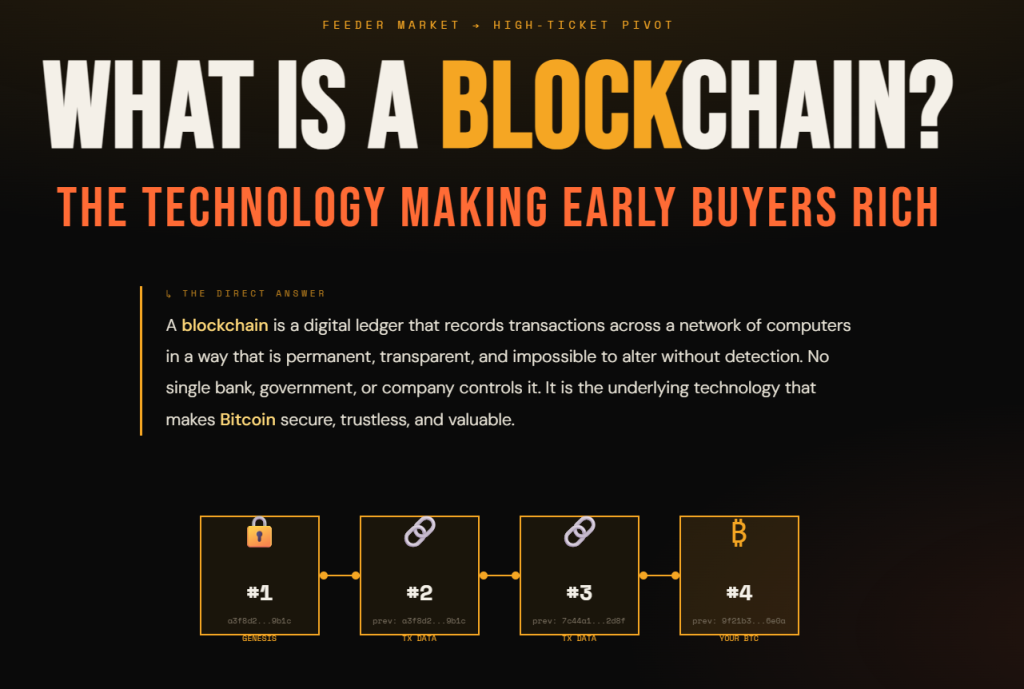
The Hidden Money Technology That’s Making Early Buyers Very Rich
A blockchain is a digital ledger that records transactions across a network of computers in a way that is permanent, transparent, and impossible to alter without detection. No single bank, government, or company controls it. It is the underlying technology that makes Bitcoin secure, trustless, and valuable.
The Pivot Introduction
This Secret Technology Could Save or Cost You Everything
You searched “what is a blockchain” because someone mentioned Bitcoin and you didn’t want to nod along pretending you understood. That’s exactly where most people start.
But here’s what nobody tells you at this stage: understanding blockchain isn’t just a vocabulary lesson. It’s the moment you realize why the financial system is quietly being rebuilt from scratch — and why the people who acted early are building wealth that’s compounding right now while most people are still asking the definition.
This secret technology called blockchain could save or cost you a decade of financial opportunity, depending on what you do with the next 5 minutes.
Because once you understand how blockchain works, the logical next question becomes: “How do I get in?” The answer, for most first-time investors, is Bitcoin — the first, largest, and most trusted application of blockchain technology in the world. Let’s break it down.
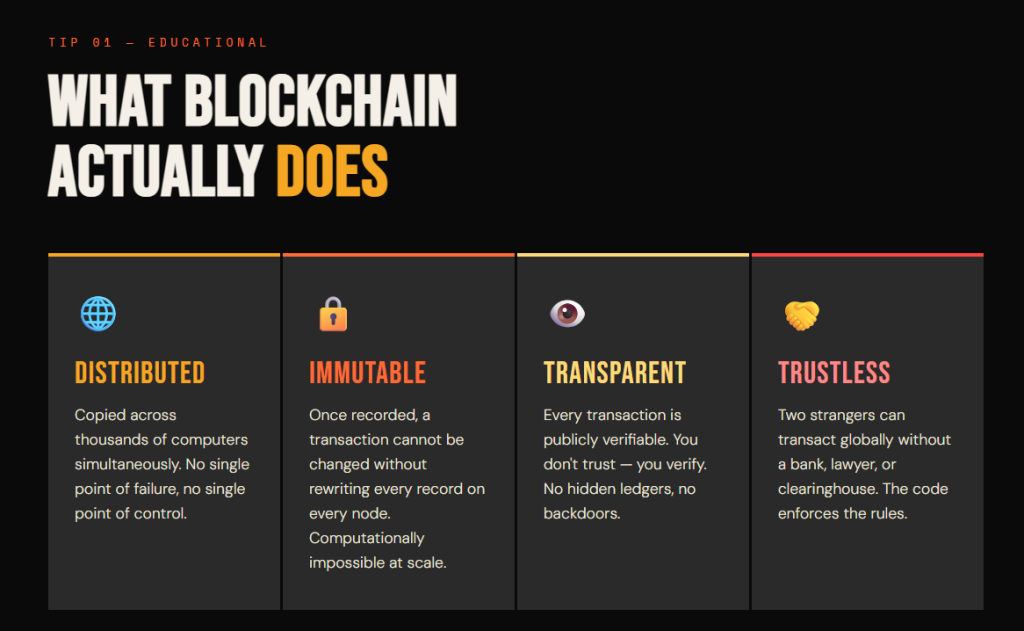
What Blockchain Actually Does (And Why It’s Revolutionary)
Forget the buzzwords. Here’s the plain-English version.
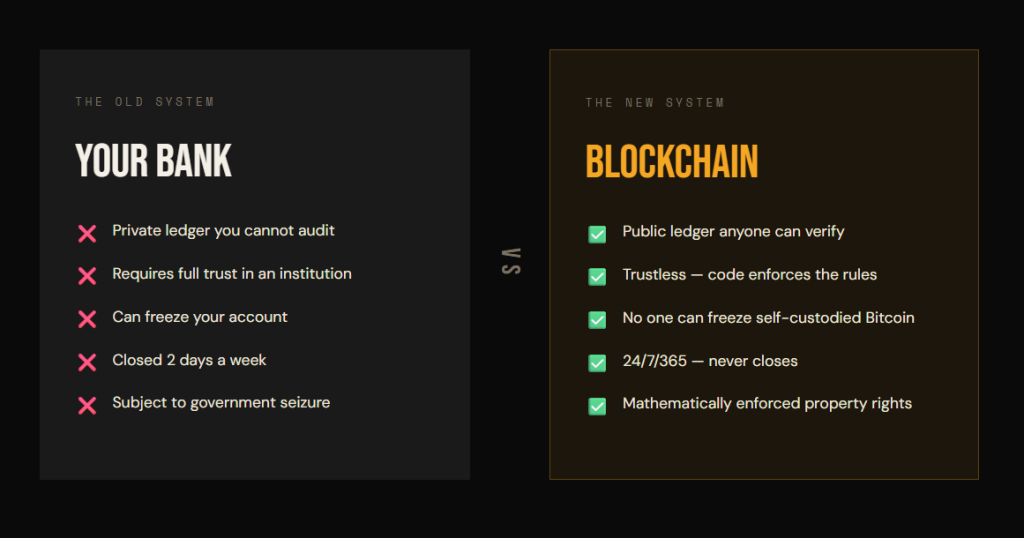
Every time you use a bank, you’re trusting a middleman to record your transaction correctly. Your bank keeps a private ledger. You can’t see it, verify it, or dispute it easily. You just… trust them.
Blockchain eliminates the middleman entirely. Instead of one private ledger held by a bank, a blockchain is a ledger that is:
- Distributed — Copied across thousands of computers (called nodes) simultaneously. No single point of failure, no single point of control.
- Immutable — Once a transaction is recorded, it cannot be changed or deleted without rewriting every subsequent record on every node. Computationally impossible at scale.
- Transparent — Every transaction is publicly verifiable. You don’t have to trust anyone because you can verify everything yourself.
- Trustless — Two strangers can transact directly, anywhere in the world, without needing a bank, a lawyer, or a clearinghouse to vouch for either party.
Bitcoin was the first application to prove this worked in the real world. When Satoshi Nakamoto launched Bitcoin in 2009, the blockchain behind it has since processed over $10 trillion in transactions without a single successful hack of the protocol itself. That’s not luck. That’s engineering.
Blockchain isn’t a product you buy. It’s a breakthrough in how trust is established between strangers without an institution in the middle. Bitcoin is the most battle-tested, valuable, and widely adopted application of that breakthrough.
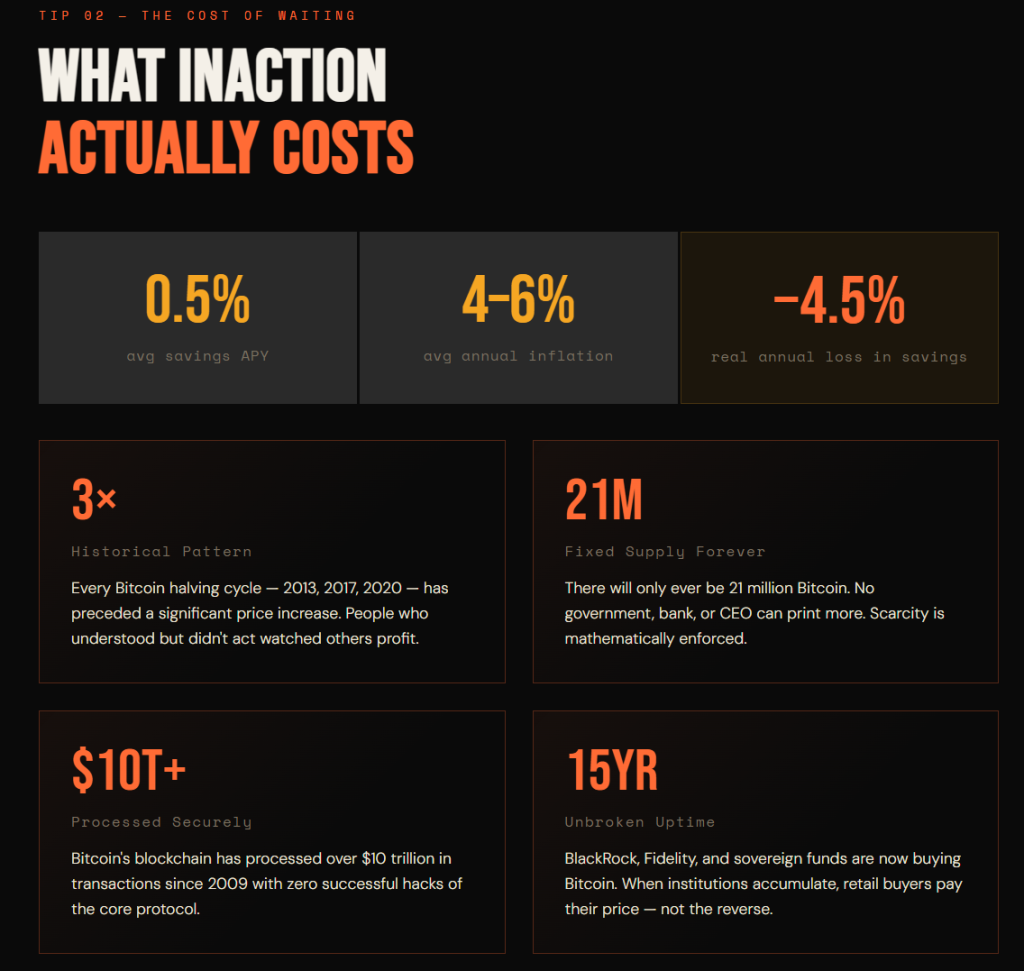
What Inaction Actually Costs You
Most people who Google “what is a blockchain” do exactly what you might be tempted to do: they read a few articles, feel slightly smarter, bookmark something, and move on.
Six months later, they watch Bitcoin’s price on the news and think, “I should have acted when I first looked into it.” This pattern has repeated itself in 2013, 2017, 2020, and 2023. Every cycle, millions of people understand blockchain just enough to watch others profit — but not enough to take action.
Here’s the specific cost of waiting:
- You’re fighting inflation with a broken weapon. The average U.S. savings account pays around 0.5% APY. Inflation has averaged 4–6% over the past three years. That means your money sitting in a bank is losing purchasing power every single month, quietly and legally.
- The institutional window is closing. BlackRock, Fidelity, MicroStrategy, and sovereign wealth funds are now buying Bitcoin at scale through approved ETFs and direct purchases. When institutions accumulate an asset, retail buyers eventually pay their price — not the other way around.
- Complexity paralysis is the most expensive mistake in investing. You don’t need to understand every line of Bitcoin’s source code to own it, just as you don’t need to understand how SWIFT works to use a bank wire. The blockchain does the work. You just need to decide to own a piece of it.
Understanding blockchain without acting on that understanding is like reading every book about swimming and never getting in the water. The knowledge is worthless without the first purchase.
How to Turn This Knowledge Into Your First Bitcoin Position
Now that you understand what blockchain does and why it creates value, the logical question is: how do you participate?
The simplest and most proven entry point is buying Bitcoin directly. Bitcoin is not just a blockchain application — it is the original, the most decentralized, and the most liquid. It has:
- 15+ years of uninterrupted uptime with zero successful protocol-level hacks
- A fixed supply of 21 million coins — making it deflationary by design
- Global liquidity — tradeable 24/7, 365 days a year, in every country
- Regulatory clarity — now approved as a spot ETF in the U.S. and recognized by institutional investors worldwide
You don’t need to buy a whole Bitcoin. Bitcoin is divisible into 100 million units called satoshis. For as little as $10, you can own a fraction of the most secure monetary network ever built.
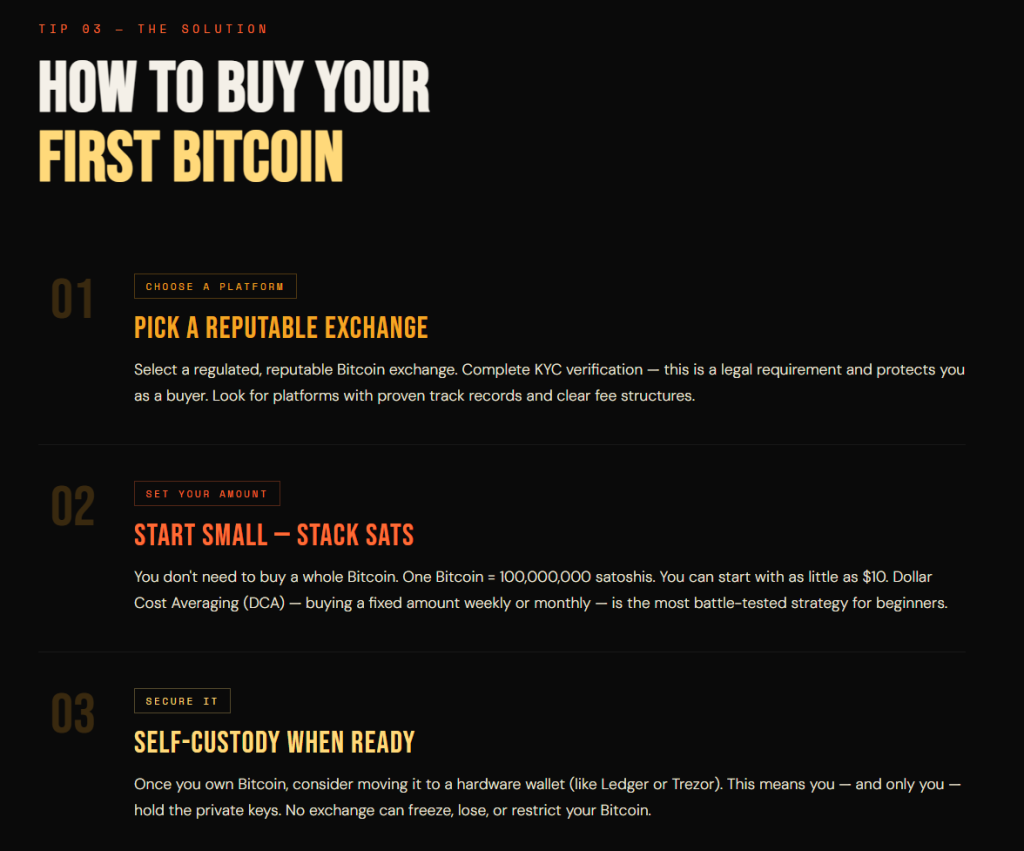
Step 1 — Pick a Reputable Exchange
Select a regulated, reputable Bitcoin exchange. Complete KYC verification — this is a legal requirement and protects you as a buyer. Look for platforms with proven track records and clear fee structures.
Step 2 — Start Small, Stack Sats
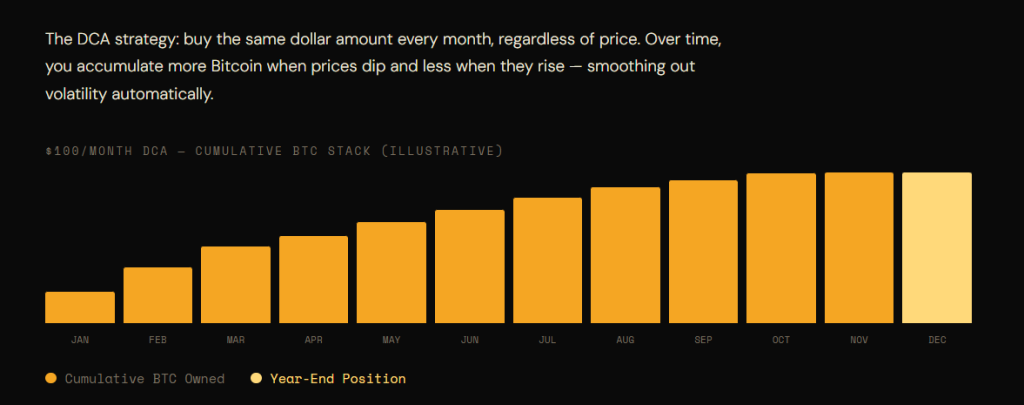
The smartest strategy for beginners is Dollar Cost Averaging (DCA) — buying a fixed dollar amount of Bitcoin on a recurring schedule (weekly or monthly) regardless of price. This removes emotion, eliminates market-timing anxiety, and has historically produced strong returns for investors who stayed consistent.
Step 3 — Self-Custody When Ready
Once you own Bitcoin, consider moving it to a hardware wallet (like Ledger or Trezor). This means you — and only you — hold the private keys. No exchange can freeze, lose, or restrict your Bitcoin.
Solution Takeaway: Blockchain is the technology. Bitcoin is the asset. And buying Bitcoin — even a small, recurring amount — is how you stop being a spectator in the biggest financial shift of your lifetime.
Downstream CTA
You Now Understand What 95% of People Still Don’t.
Most people will read this, nod, and go back to their 0.5% savings account. But you’re here because you sense something is changing — and you want to be on the right side of it.
The next step is simple:
→ [Buy Your First Bitcoin Today — Start With as Little as $10]
No jargon. No complex wallets required to start. Just a straightforward, secure way to own the hardest monetary asset ever created — backed by the most revolutionary financial technology since the internet.
→ [Get Started Now — Your First Bitcoin Purchase Takes Less Than 5 Minutes]
Disclosure: This article is for educational purposes only and does not constitute financial advice. All investments carry risk. Please do your own research before making any investment decisions.
Frequently Asked Questions: What Is a Blockchain
What is a blockchain in simple terms?
A blockchain is a shared database that runs across thousands of computers simultaneously, with no single owner. Records are grouped into “blocks” that are linked together in a chain. Each block contains a cryptographic fingerprint of the previous block, so altering any record would break every block that follows — making the history tamper-evident. Bitcoin was the first application of blockchain technology, using it to record transactions without a bank or central authority.
How is a blockchain different from a regular database?
A regular database is controlled by a central authority — a company, government, or administrator who can modify or delete records. A public blockchain is controlled by no single entity; it is maintained by thousands of independent nodes following the same rules. This means no one can unilaterally reverse a transaction, freeze an account, or alter history. The trade-off is that blockchains are slower and more expensive to operate than centralized databases, which is why they are used for high-trust, high-value applications.
What is the difference between Bitcoin and Ethereum blockchains?
Bitcoin’s blockchain is optimized for one thing: recording peer-to-peer transactions securely. It uses Proof-of-Work consensus and processes about 7 transactions per second. Ethereum’s blockchain is a programmable platform — in addition to recording transactions, it runs smart contracts: programs that execute automatically when conditions are met. Ethereum processes hundreds of transactions per second across its Layer 2 networks and powers the entire DeFi ecosystem, NFT markets, and decentralized applications.
Is blockchain technology secure?
Public blockchains like Bitcoin and Ethereum are extremely difficult to attack at the protocol level. Altering Bitcoin’s history would require controlling more than 50% of the global mining hash rate — a feat that would cost billions and be immediately visible to the network. The security risks in crypto are almost never the blockchain itself, but rather the applications built on top of it: exchange hacks, smart-contract bugs, phishing attacks, and user error (lost private keys). The underlying ledger is secure; the perimeter around it requires vigilance.
What can blockchain technology be used for besides crypto?
Blockchain’s tamper-evident ledger is useful anywhere trust and verification are expensive: supply chain tracking (verifying product origin and handling), medical records (patient-controlled health data), real estate (tokenized property ownership and faster settlement), voting systems (auditable ballot records), and financial instruments (tokenized bonds, stocks, and funds). BlackRock, JPMorgan, and most major banks now run blockchain pilots. The technology is real — the challenge is finding use cases where decentralization adds enough value to justify the added complexity.

Bernard Mudafort is the founder and lead writer of bitcoinethxrp.com. He has been active in DeFi since 2018 and has personally tested yield farming strategies on Aave, Curve, Uniswap, and Arbitrum, focusing on sustainable, risk-managed approaches to crypto passive income.